
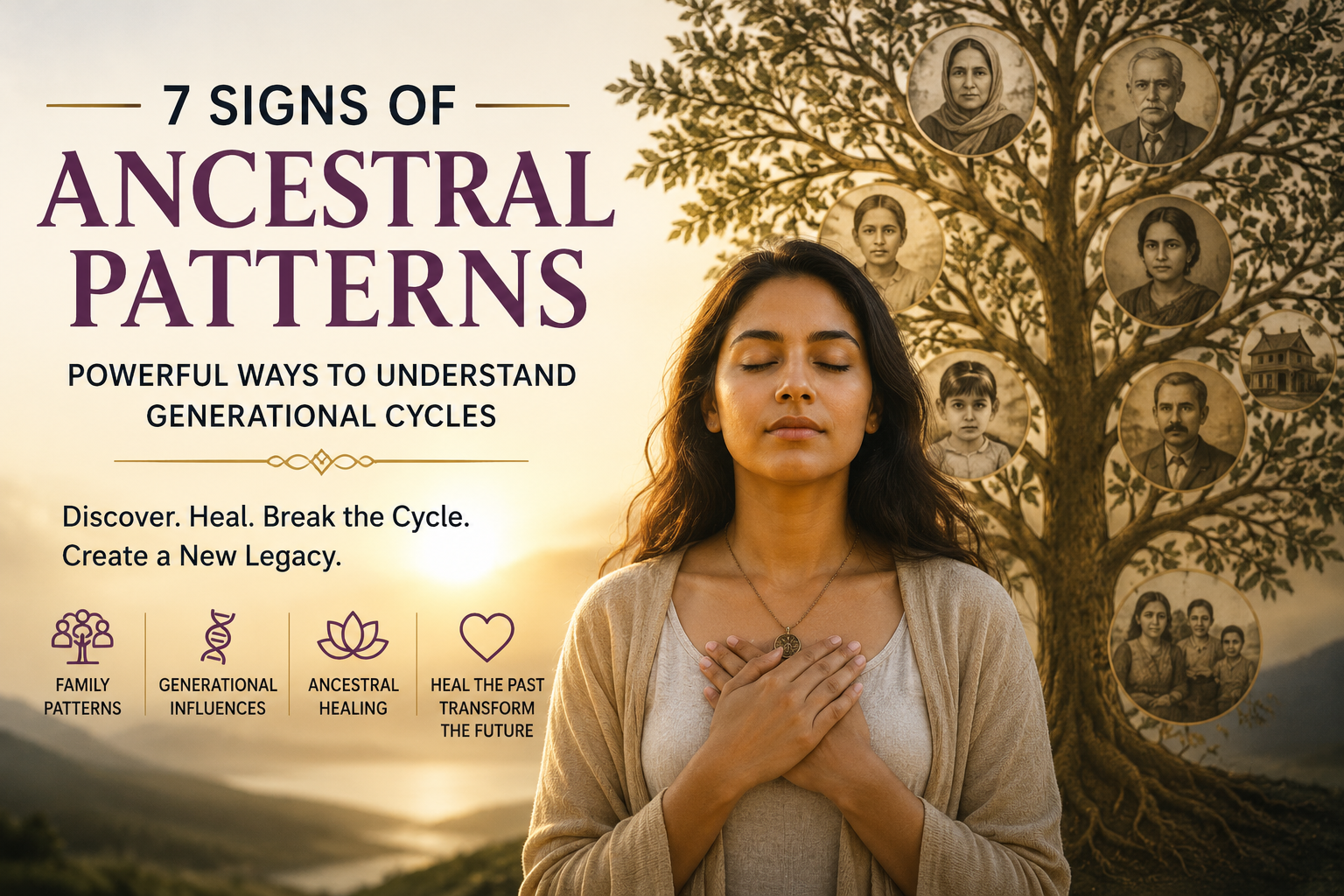
Have you ever noticed that certain struggles seem to repeat in your family?
Perhaps several generations have experienced similar relationship difficulties. Maybe financial fear has been present in your family for as long as you can remember. Or perhaps emotional patterns, family roles or beliefs seem to be passed from one generation to another.
You may have wondered:
“Why does this keep happening in my family?”
“Is this simply coincidence, or could there be a deeper pattern?”
This is where the concept of ancestral patterns comes into the conversation.
Ancestral patterns are a spiritual and holistic way of exploring recurring themes that people believe may be connected to their family lineage. These can overlap with learned behaviours, family beliefs, cultural conditioning and other forms of intergenerational influence and ancestral patterns.
From a spiritual perspective, some people explore ancestral healing as a way of becoming more aware of these patterns and consciously changing how they participate in them.
In this article, we will explore 7 possible signs of ancestral patterns, how family and generational patterns may develop, and how ancestral healing can be approached responsibly.
Table of Contents
- What Are Ancestral Patterns?
- Ancestral Patterns vs Generational Patterns
- 7 Signs of Ancestral Patterns
- How Family Patterns Can Influence Your Life
- Are Ancestral Patterns the Same as Ancestral Trauma?
- How Ancestral Healing Works
- How Generational Healing Can Begin
- Can Karma Healing Help You Explore Ancestral Patterns?
- What Ancestral Healing Can and Cannot Do
- When Should You Seek Professional Support?
- Frequently Asked Questions
- Final Thoughts
What Are Ancestral Patterns?
Ancestral patterns refer to recurring themes, beliefs, behaviours or emotional dynamics that people may associate with their family lineage.
For example, imagine that financial insecurity has affected several generations of a family.
A grandparent may have experienced severe financial uncertainty.
Their children may have grown up believing:
“Money can disappear at any time.”
They may then become extremely cautious with money.
Their children may inherit the same fear even though they have never personally experienced the original event.
In this situation, the pattern may be transmitted through family stories, behaviours, beliefs and emotional conditioning.
Some spiritual traditions add another layer to this understanding by exploring ancestral energy or karma.
These spiritual interpretations are different from established psychological explanations and should be treated as spiritual frameworks rather than proven scientific mechanisms.
Ancestral Patterns vs Generational Patterns
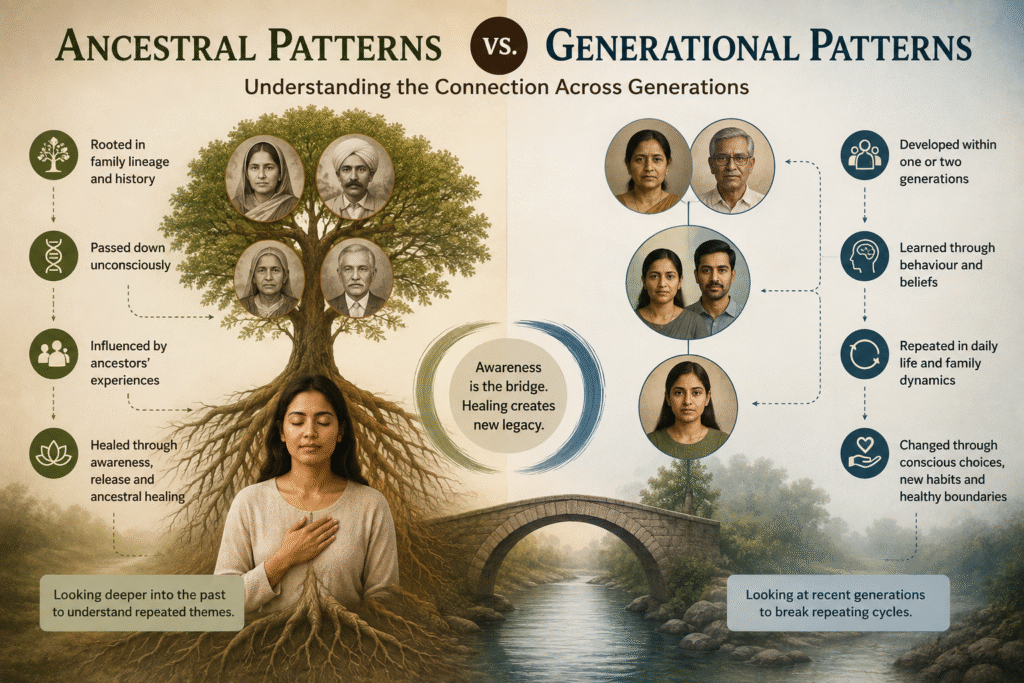
The terms ancestral patterns and generational patterns are often used interchangeably, but they can have slightly different meanings.
Ancestral Patterns
Ancestral patterns generally refer to recurring experiences or themes that are believed to have connections with previous generations or a family lineage.
Generational Patterns
Generational patterns can describe behaviours, beliefs and emotional dynamics that are learned or repeated across generations.
For example:
Grandmother: avoids talking about emotions.
↓
Mother: avoids emotional conversations.
↓
Daughter: finds it difficult to express vulnerability.
This could be understood as a generational pattern through learned behaviour.
A spiritual practitioner might additionally explore it as an ancestral pattern.
Both perspectives can be considered separately without assuming that one explanation applies to every family.
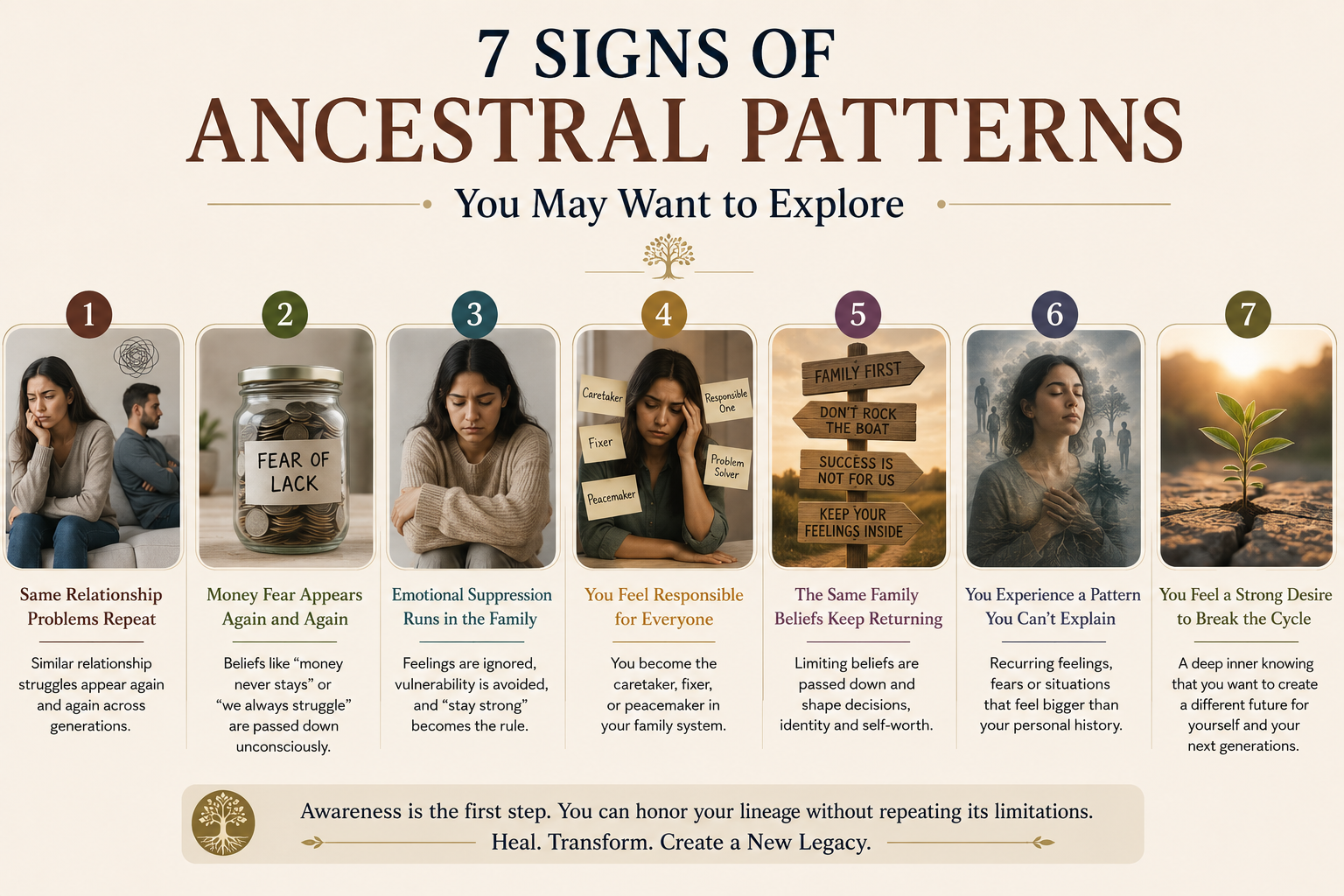
7 Signs of Ancestral Patterns You May Want to Explore
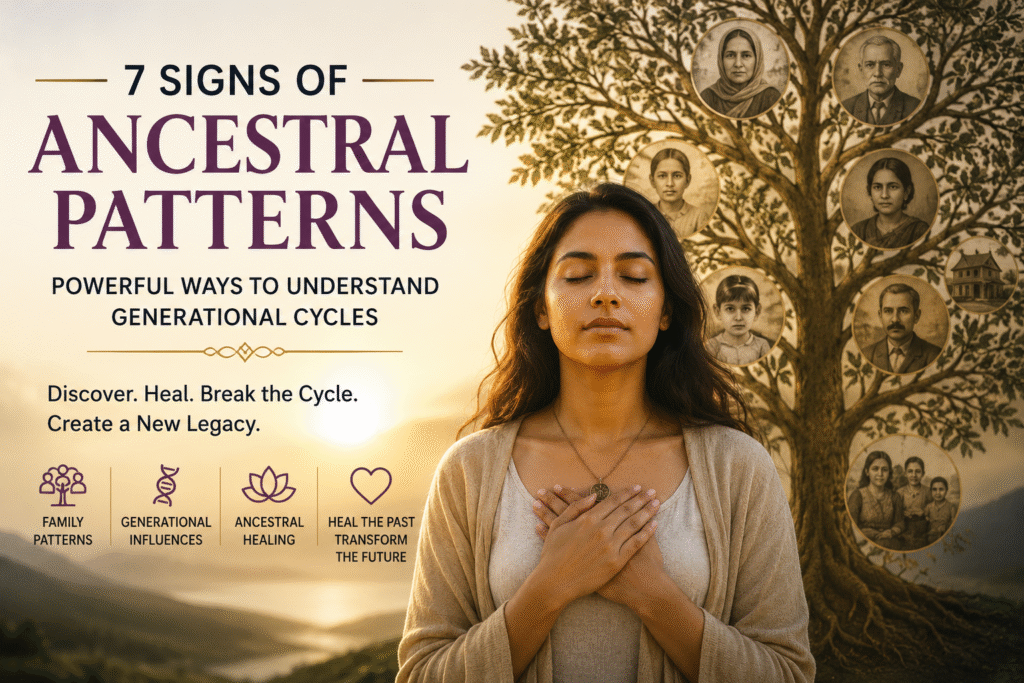
Not every repeated family experience is necessarily an ancestral pattern.
These signs are best viewed as reflection points, not proof that an ancestral cause exists.
1. The Same Relationship Problems Repeat Across Generations
One of the most noticeable family patterns can involve relationships.
For example, you may notice:
- repeated relationship conflict
- emotionally unavailable partners
- repeated separation or divorce
- difficulty expressing emotions
- people-pleasing
- difficulty trusting partners
- unhealthy communication patterns
Perhaps your grandmother struggled with emotional connection.
Your mother experienced something similar.
Now you find yourself experiencing a related pattern.
That doesn’t automatically mean there is an ancestral cause.
Family modelling, environment, attachment experiences and social expectations can also influence relationships.
However, noticing the repetition can be an important opportunity for self-reflection.
2. Money Fear Appears Again and Again
Another common area where people notice generational patterns is money.
You may hear statements such as:
- “Money never stays.”
- “We have to struggle to survive.”
- “Rich people cannot be trusted.”
- “You should never take financial risks.”
- “Our family has always struggled financially.”
These beliefs can influence how people think about earning, saving, spending and receiving money.
A person may consciously want financial freedom while unconsciously carrying a deep fear of losing what they have.
When several generations share similar beliefs, some people explore these experiences through the concept of ancestral patterns.
From a practical perspective, it is also useful to examine actual financial behaviour, financial education and family attitudes toward money.
3. Emotional Suppression Runs in the Family
Does your family find it difficult to talk about emotions?
Maybe difficult subjects are ignored.
Perhaps family members rarely apologise.
Maybe vulnerability is considered weakness.
Or perhaps everyone is expected to “stay strong” regardless of what they are experiencing.
These can become powerful family patterns.
A child learns what emotional expression looks like by observing the people around them.
If emotional suppression continues across generations, it may become part of the family’s normal communication style.
Recognising this pattern can be the first step toward creating a different emotional environment.
4. You Feel Responsible for Everyone
Another possible sign is a repeated family role.
You may find yourself becoming:
- the family problem-solver
- the emotional caretaker
- the peacekeeper
- the responsible child
- the person everyone calls during a crisis
- the person who sacrifices personal needs
You may even feel guilty when you prioritise yourself.
Sometimes these roles develop because of family circumstances.
Over time, however, they can become deeply established.
If similar roles appear across generations, you may want to explore whether you are continuing a generational pattern that no longer serves you.
5. The Same Family Beliefs Keep Returning
Every family develops beliefs.
Some are helpful.
Others may become limiting.
Examples include:
“You should always put family first.”
“Marriage is supposed to be difficult.”
“You cannot trust outsiders.”
“You must choose security over happiness.”
“People like us don’t become successful.”
These statements may appear harmless because they have been repeated for years.
But beliefs can influence decisions.
They can affect relationships, careers, money and self-worth.
One part of generational healing is becoming aware of which beliefs you want to continue and which ones you want to reconsider.
6. You Experience a Pattern You Cannot Easily Explain
Sometimes people report feeling that they are carrying an emotional experience that seems bigger than their personal history.
For example, they may experience:
- unexplained fear
- recurring emotional themes
- intense family-related guilt
- persistent feelings of unworthiness
- repeated relationship dynamics
- a strong emotional connection to family history
There can be many explanations for these experiences.
Psychological, social, environmental and personal factors should all be considered.
People who follow spiritual practices may also explore these experiences through ancestral healing or karmic frameworks.
The purpose should be curiosity and self-awareness—not fear.
7. You Feel a Strong Desire to Break the Family Cycle
Sometimes the clearest sign isn’t a problem.
It is the desire to create something different.
You may think:
“I don’t want my children to experience what I experienced.”
Or:
“I want relationships in my family to become healthier.”
Or:
“I want to change how my family talks about money.”
This desire can become the starting point for generational healing.
You don’t have to change your entire family.
You can begin by changing your own choices, boundaries, beliefs and responses.
How Family Patterns Can Influence Your Life
Family patterns can be transmitted in many ways.
Through Behaviour
Children observe how parents communicate, handle conflict and respond to stress.
Over time, these behaviours can become familiar.
Through Beliefs
Family members often pass beliefs to children through everyday conversations.
Statements about money, marriage, success and emotional expression can become internalised.
Through Family Roles
Some families unconsciously assign roles.
One child may become the responsible one.
Another may become the peacemaker.
Another may become the rebel.
These roles can continue into adulthood.
Through Family Stories
Stories influence identity.
Repeated stories such as:
“Our family has always struggled.”
can shape the way a person understands their own possibilities.
Through Cultural and Social Experiences
Families can also be influenced by major historical and social experiences.
Migration, economic hardship, conflict, discrimination, loss and social expectations can shape family beliefs and behaviours across generations.
This is one reason it is important to approach ancestral work with sensitivity and avoid assuming that every challenge has a spiritual explanation.
Are Ancestral Patterns the Same as Ancestral Trauma?
No.
These terms should not be treated as identical.
Ancestral patterns is a broad spiritual/holistic term that may refer to recurring family themes.
Intergenerational or ancestral trauma is used in psychological and research contexts to discuss how the effects of traumatic experiences may influence subsequent generations.
The evidence and mechanisms being discussed are different.
Therefore, an article about spiritual ancestral healing should not claim that spiritual energy, karma or ancestral patterns are scientifically proven explanations for psychological or medical conditions.
This distinction is important for responsible healing content.
How Ancestral Healing Works
Ancestral healing can mean different things depending on the practitioner and tradition.
Some approaches may include:
- guided meditation
- family-pattern reflection
- visualisation
- energy practices
- spiritual rituals
- journaling
- lineage exploration
- emotional awareness
- forgiveness practices
- symbolic release exercises
At The Healing Wiz, ancestral healing is presented within a broader Karma Healing framework that explores recurring family and energetic patterns. The existing Nneihaa Vvikas content describes tracing recurring family themes and using energy-clearing and chakra-focused practices as part of its approach.
Different practitioners use different methods, so readers should always understand what a particular session actually involves.
How Generational Healing Can Begin
You don’t necessarily need to start with a healing session.
You can begin with awareness.
Step 1: Identify the Repeating Pattern
Write down what seems to repeat.
For example:
Relationship conflict → emotional withdrawal → silence → resentment
or:
Money arrives → fear increases → overspending → financial stress
The clearer the pattern, the easier it becomes to examine.
Step 2: Look Across Generations
Ask yourself:
- Did my parents experience something similar?
- Did my grandparents experience it?
- What family stories surround this pattern?
- What beliefs were passed down?
You don’t need to force a connection.
Simply observe.
Step 3: Separate Facts From Interpretation
This is extremely important.
Write:
What I know:
“My mother experienced a difficult divorce.”
Then separately:
My interpretation:
“I may be repeating a relationship pattern.”
Keeping these separate prevents assumptions from becoming “facts.”
Step 4: Identify What You Want to Change
Ask:
“What do I want the next generation to experience differently?”
This shifts the focus from blame to conscious choice.
Step 5: Create a New Response
Breaking generational patterns can involve practical changes such as:
- communicating openly
- setting healthier boundaries
- changing financial habits
- learning emotional regulation
- developing healthier relationship skills
- seeking counselling or therapy when appropriate
- using spiritual practices as complementary support
Can Karma Healing Help You Explore Ancestral Patterns?
Karma Healing is a spiritual framework that some people use to explore recurring experiences through concepts such as karmic patterns, energetic imprints and ancestral influences.
The Healing Wiz currently positions Karma Healing around recurring patterns involving areas such as relationships, health, wealth and family experiences.
For someone interested in spiritual exploration, this framework may provide a way to reflect on questions such as:
- What keeps repeating?
- What family story am I carrying?
- Which beliefs no longer serve me?
- What am I ready to release?
- What do I want to change for the future?
The goal should be greater awareness and personal agency—not fear or dependence.
What Ancestral Healing Can and Cannot Do
Ancestral Healing May Help You:
- reflect on family history
- identify recurring patterns
- explore family beliefs
- become more aware of emotional responses
- develop personal boundaries
- engage in spiritual self-reflection
- create intentional changes
Ancestral Healing Should Not Be Presented As:
- a guaranteed cure for illness
- a replacement for therapy
- a replacement for medical treatment
- proof that ancestors are causing current problems
- a guaranteed method of changing another person’s behaviour
- a guarantee of financial or relationship outcomes
Responsible ancestral healing content should leave room for both spiritual exploration and practical support.
When Should You Seek Professional Support?
If you are experiencing significant psychological distress, trauma symptoms, depression, anxiety, self-harm thoughts or suicidal thoughts, seek support from a qualified mental-health professional.
Spiritual practices can be complementary for some people, but they should not replace appropriate professional care.
Similarly, medical conditions should be evaluated and treated by qualified healthcare professionals.
This distinction is particularly important when discussing healing and wellbeing online.
Frequently Asked Questions
What are ancestral patterns?
Ancestral patterns are a spiritual or holistic term for recurring themes, beliefs or experiences that people associate with their family lineage.
What are generational patterns?
Generational patterns are recurring behaviours, beliefs or family dynamics that may be learned or repeated across generations.
What is ancestral healing?
Ancestral healing refers to various spiritual and holistic practices focused on exploring perceived family-lineage patterns and creating greater awareness around them.
What are examples of family patterns?
Examples can include repeated relationship dynamics, emotional suppression, money beliefs, family roles, communication styles and attitudes toward success.
Can ancestral patterns affect relationships?
Family experiences and learned behaviours can influence relationships. Spiritual traditions may also interpret recurring relationship experiences through ancestral or karmic frameworks.
Can I break generational patterns?
You can consciously change your own behaviours, beliefs, boundaries and responses even when other family members do not change.
Is ancestral healing the same as therapy?
No. Ancestral healing is generally presented as a spiritual or holistic practice, while therapy is a professional mental-health service.
Do I need to know my ancestors to explore ancestral healing?
Not necessarily. Different practitioners use different methods. Some focus on known family history, while others use guided or symbolic spiritual practices..
Ready to Explore Your Pattern?
If you feel that a recurring pattern in your relationships, money or family life may have deeper roots, you can begin by exploring the Karma Healing approach at The Healing Wiz.
Take the Clarity call to explore your current pattern and discover an appropriate next step.