

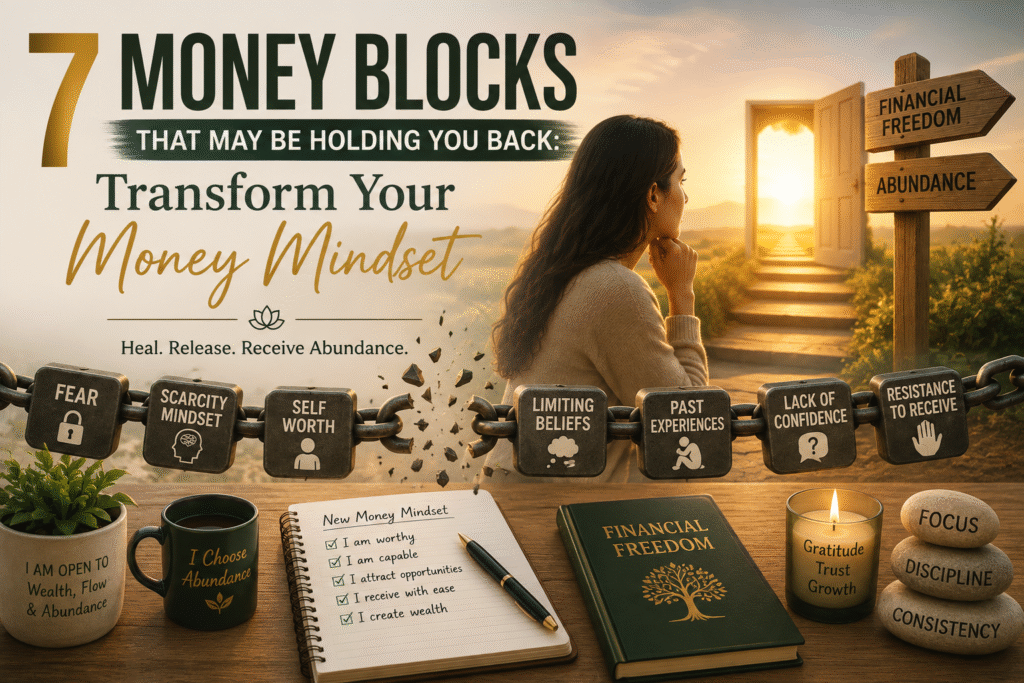
Do you ever feel like you are working hard for money, but something always seems to get in the way?
Maybe you earn more but still feel financially stressed.
Maybe you find it difficult to charge what your work is worth.
Maybe you save money and then suddenly feel the urge to spend it.
Or perhaps you constantly worry that the money you have will disappear.
Sometimes the problem may not simply be about how much money you earn.
It may also be about your relationship with money.
The beliefs, emotions and behaviours you develop around money can influence the way you earn, spend, save, receive and think about financial security.
These patterns are often described as money blocks in personal-development and spiritual communities.
From a psychological perspective, money behaviours can be influenced by stress, learned beliefs, habits and decision-making patterns. The American Psychological Association notes that financial stress can affect behaviour and relationships, while avoiding financial problems can sometimes make anxiety worse.
From a spiritual perspective, some people explore these experiences through concepts such as money karma, energetic patterns and abundance blocks.
This article explores both perspectives so you can understand your relationship with money more clearly.
Table of Contents
- What Are Money Blocks?
- What Is a Money Mindset?
- 7 Common Money Blocks
- What Is a Scarcity Mindset?
- What Are Abundance Blocks?
- Can Family Experiences Influence Your Money Mindset?
- What Is Money Karma?
- How to Start Releasing Money Blocks
- Practical Steps to Improve Your Financial Wellbeing
- How Karma Healing Approaches Money Blocks
- When Should You Seek Professional Financial Support?
- Frequently Asked Questions
- Final Thoughts
What Are Money Blocks?
Money blocks is a term commonly used in personal development and spiritual communities to describe beliefs, emotions or behaviours that may make it difficult for someone to feel comfortable with earning, receiving, saving or managing money.
For example, someone might believe:
“I am not good with money.”
Another person might think:
“People like me don’t become wealthy.”
Someone else might feel guilty whenever they spend money on themselves.
These beliefs don’t automatically mean that a person has a spiritual problem.
They may have developed through:
- childhood experiences
- family beliefs
- financial hardship
- social conditioning
- previous financial mistakes
- fear
- shame
- lack of financial education
- repeated stressful experiences
Understanding the source of a money pattern can be more useful than simply labelling it.
What Is a Money Mindset?
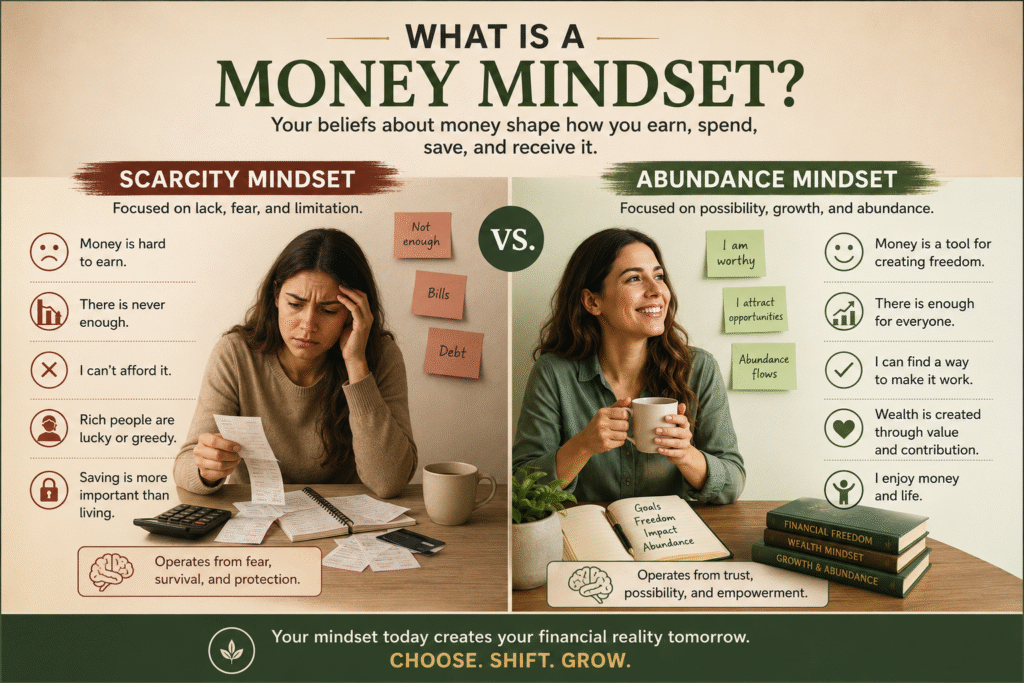
Your money mindset refers broadly to the beliefs and attitudes you have about money.
Think about the following statements:
Positive or flexible beliefs
- “I can learn how to manage money.”
- “I can improve my financial habits.”
- “I can charge fairly for valuable work.”
- “I can make mistakes and learn from them.”
Restrictive beliefs
- “Money always disappears.”
- “I will never have enough.”
- “Wanting money makes me selfish.”
- “Rich people cannot be trusted.”
- “I have to struggle to deserve success.”
A money mindset is not a substitute for financial knowledge.
You can have a positive attitude toward money and still need better budgeting, saving or debt-management skills.
Likewise, improving your financial knowledge can help you make better decisions even when emotional beliefs are still present.
The Consumer Financial Protection Bureau defines financial wellbeing in terms of factors such as control over day-to-day finances, capacity to handle financial shocks, progress toward financial goals and freedom of choice.
7 Common Money Blocks That May Be Affecting You
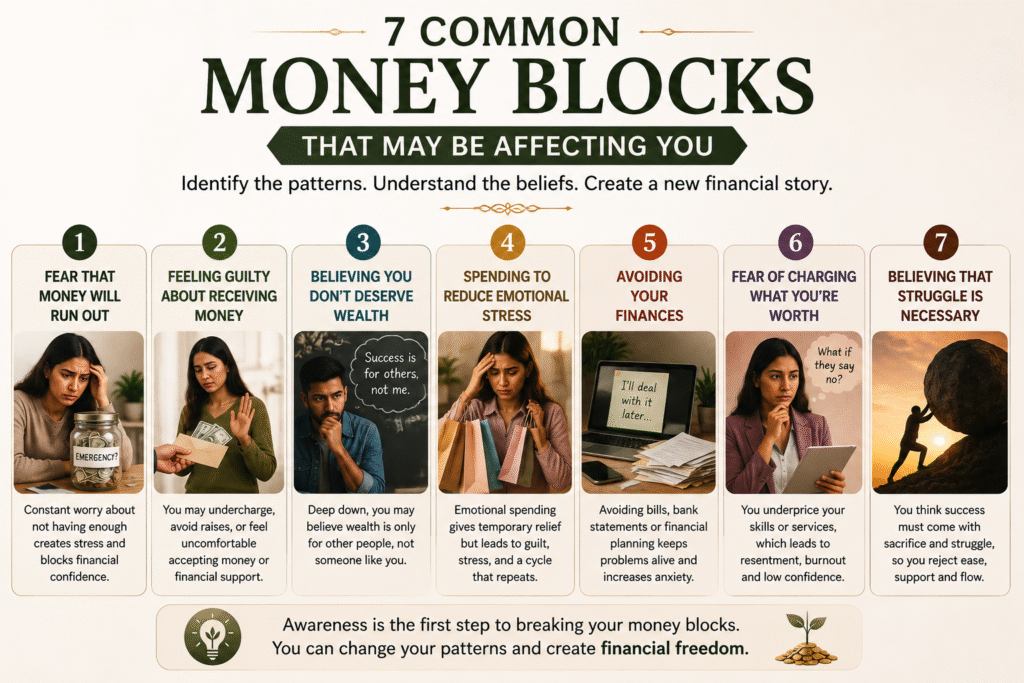
1. Fear That Money Will Run Out
One of the most common patterns is a constant fear of not having enough.
Even when you have money available, you may still think:
“What if something happens?”
“What if I lose everything?”
“What if I don’t have enough later?”
This can create a persistent scarcity mindset.
Financial caution can be useful.
But constant fear can make it difficult to enjoy your current financial situation or make calm decisions.
The goal isn’t to ignore financial risks.
It is to learn the difference between healthy financial planning and constant financial fear.
2. Feeling Guilty About Receiving Money
Do you feel uncomfortable asking for payment?
Perhaps you:
- undercharge clients
- avoid negotiating
- give excessive discounts
- feel guilty receiving gifts
- hesitate to ask for a raise
- believe helping people should always be free
This can become a significant money block for entrepreneurs, freelancers and service professionals.
Ask yourself:
“Do I believe receiving money makes me less generous?”
Money and generosity don’t have to be opposites.
You can serve people while also valuing your time, skills and work.
3. Believing You Don’t Deserve Wealth
Another possible money block is the belief that financial success belongs to “other people.”
You may think:
“I’m not the kind of person who becomes wealthy.”
“People like me don’t earn that much.”
“I don’t deserve more than what I have.”
These beliefs can influence your behaviour.
You may avoid opportunities.
You may hesitate to promote yourself.
You may stop before reaching a bigger goal.
The belief doesn’t necessarily create the financial outcome by itself—but it can influence your decisions.
4. Spending Money to Reduce Emotional Stress
Sometimes spending becomes an emotional coping mechanism.
You feel stressed.
You buy something.
You experience temporary relief.
Then guilt appears.
The cycle becomes:
Stress → Spending → Temporary Relief → Guilt → More Stress
The APA has highlighted the relationship between financial stress, emotional responses and unhealthy coping behaviours, and recommends identifying financial stressors rather than avoiding them.
If this pattern feels familiar, the solution isn’t simply to shame yourself for spending.
Instead, ask:
“What emotion am I trying to change when I spend?”
5. Avoiding Your Finances
One of the most important money blocks may actually be financial avoidance.
You might:
- avoid checking your bank balance
- ignore bills
- delay reviewing expenses
- avoid discussing money with your partner
- postpone debt repayment
- refuse to create a financial plan
Avoidance can feel comforting in the short term.
But the problem remains.
The APA specifically recommends identifying financial stressors and creating a concrete plan rather than avoiding financial problems.
6. Fear of Charging What You’re Worth
This is particularly common among people who provide services.
You know your work has value.
But when it comes to stating your price, you become uncomfortable.
You might think:
“What if they say no?”
“What if they think I’m expensive?”
“Maybe I should charge less.”
This can become a cycle:
Low confidence → low pricing → resentment → overworking → burnout → more self-doubt
A healthier approach is to separate:
Your personal worth
from
the price of a particular product or service.
Your worth as a human being isn’t determined by your income.
At the same time, your professional service can have a fair and clearly communicated price.
7. Believing That Struggle Is Necessary for Success
Some people grow up hearing:
“Nothing comes easily.”
“You have to suffer to succeed.”
“Money only comes through hard work.”
Hard work can absolutely be valuable.
But if you believe suffering is a requirement for success, you may unconsciously reject opportunities that feel easier.
You may overwork.
You may refuse help.
You may feel guilty when things become easier.
This is where examining your money mindset can become powerful.
Ask:
“Can success involve effort without requiring constant suffering?”
What Is a Scarcity Mindset?
A scarcity mindset is a way of thinking that focuses heavily on lack.
You may constantly think:
- There isn’t enough money.
- There isn’t enough time.
- Someone else will get the opportunity.
- I have to protect everything I have.
- I can’t afford to make a mistake.
Scarcity can sometimes be a realistic response to genuine financial pressure.
If you are struggling with debt, unemployment or basic expenses, the answer isn’t simply to “think abundant.”
You need practical financial support too.
But when scarcity thinking continues even after circumstances improve, it may be worth examining the beliefs and emotions behind it.
What Are Abundance Blocks?
Abundance blocks is another spiritual/self-development term used to describe beliefs or emotional resistance around receiving opportunities, money or success.
Examples may include:
- discomfort receiving
- fear of success
- guilt about having more than others
- fear of responsibility
- fear of being judged
- difficulty accepting compliments
- feeling undeserving of opportunities
Again, these are not medical diagnoses.
They are useful concepts for self-reflection within certain personal-development and spiritual frameworks.
Can Family Experiences Influence Your Money Mindset?
Absolutely, family experiences can influence the way people learn to think and behave around money.
Imagine growing up hearing:
“Money doesn’t grow on trees.”
“We can never afford anything.”
“You should always save because something bad might happen.”
These statements can become deeply familiar.
Family financial experiences may also influence:
- spending habits
- saving habits
- risk tolerance
- attitudes toward debt
- career decisions
- views about wealth
- beliefs about security
This doesn’t mean that your parents or ancestors determine your financial future.
It means that your financial story may contain beliefs worth examining.
This is also where your ancestral patterns content can connect naturally with this article.
What Is Money Karma?
Money karma is a spiritual concept used by some practitioners to describe recurring financial patterns through a karmic or energetic framework.
Within this perspective, someone may explore questions such as:
- Why does the same financial pattern keep repeating?
- Why do I feel uncomfortable receiving money?
- Why do I repeatedly experience fear around wealth?
- Are there family or ancestral beliefs influencing my relationship with money?
- What emotional pattern am I ready to release?
These questions can be meaningful for someone who follows a spiritual approach.
However, money karma should not be presented as a scientifically established cause of financial outcomes.
Your financial situation can also be influenced by income, expenses, education, employment, debt, economic conditions, financial decisions and many other practical factors.
A balanced approach considers both.
How to Start Releasing Money Blocks
You don’t have to change everything at once.
Start with awareness.
Step 1: Write Down Your Money Beliefs
Complete these sentences:
Money is…
Rich people are…
People with money…
If I become wealthy…
If I lose my money…
Charging more means…
Your answers can reveal beliefs you may not have consciously noticed.
Step 2: Identify Your Emotional Money Triggers
Notice what happens when you:
- receive money
- spend money
- lose money
- ask for money
- discuss money
- set a financial goal
Do you feel:
- fear?
- guilt?
- excitement?
- shame?
- anxiety?
- confidence?
- resistance?
Awareness comes before change.
Step 3: Separate Beliefs From Facts
Write two columns.
Belief
“Money always disappears.”
Fact
“I need to understand where my money is going each month.”
This simple distinction can help you move from fear toward action.
Step 4: Look at Your Actual Numbers
Spiritual work should not replace practical financial awareness.
Look at:
- monthly income
- fixed expenses
- variable expenses
- debt
- savings
- investments
- emergency funds
- financial goals
The CFPB’s financial-wellbeing framework similarly focuses on whether people have control over their finances, can absorb financial shocks and are progressing toward their goals.
Step 5: Change One Financial Behaviour
Don’t try to completely transform your financial life overnight.
Choose one behaviour.
For example:
This month I will track my spending.
Or:
I will review my subscriptions.
Or:
I will create an emergency savings goal.
Or:
I will have one honest conversation about money with my partner.
Small changes can create evidence that your financial behaviour is changeable.
Step 6: Explore the Emotional Pattern
Once your practical finances are clearer, explore the emotional side.
Ask:
“What does money represent to me?”
Does it represent:
- safety?
- freedom?
- status?
- love?
- control?
- survival?
- independence?
Money can carry emotional meaning beyond its numerical value, and the APA recommends examining what money represents personally when working through money-related stress.
Step 7: Explore a Spiritual Framework If It Resonates With You
If you are interested in spiritual healing, you may explore:
- meditation
- journaling
- energy practices
- ancestral work
- Karma Healing
- inner-child work
- guided reflection
These can be complementary practices for self-reflection.
They should not replace financial advice, debt counselling or professional mental-health support when those are needed.
How Karma Healing Approaches Money Blocks
At The Healing Wiz, Money Karma Healing is positioned as part of its broader Karma Healing framework.
The current program describes Money Karma Healing around identifying perceived karmic patterns affecting finances, exploring past-life/ancestral money themes, working with scarcity and money fears, and using subconscious/visualisation practices around abundance.
For someone interested in this spiritual framework, the exploration may include questions such as:
What pattern keeps repeating?
Is the same financial experience appearing again and again?
What belief is underneath the pattern?
Are you carrying fear, guilt or unworthiness around money?
Is there a family story?
Do certain money beliefs appear repeatedly within your family?
What do you want to change?
Instead of focusing only on “getting more money,” the process can also focus on developing a healthier relationship with receiving, decision-making and financial self-awareness.
Money Healing Should Be About More Than “Attracting Money”
This distinction can make your article stronger than many competing spiritual articles.
Financial wellbeing isn’t simply:
“How much money can I attract?”
It can also involve:
- financial security
- control
- informed decisions
- freedom of choice
- resilience
- healthy behaviours
- emotional wellbeing
The CFPB specifically defines financial wellbeing around security and freedom of choice rather than simply income or net worth.
So a healthy money-healing conversation can include both:
Inner work + practical action
rather than promising instant wealth.
When Should You Seek Professional Financial Support?
Money blocks content should never encourage someone to ignore serious financial problems.
If you’re dealing with:
- significant debt
- inability to pay essential bills
- investment decisions
- tax problems
- business financial problems
- bankruptcy concerns
- legal financial issues
consider speaking with an appropriately qualified financial professional.
If money stress is causing severe anxiety, depression or other significant psychological distress, a qualified mental-health professional may also be appropriate.
The APA recommends seeking financial planning/credit counselling support for financial difficulties and psychological support when financial stress becomes overwhelming.
Frequently Asked Questions
What are money blocks?
Money blocks is a personal-development term used to describe beliefs, emotions or behaviours that may make it difficult to earn, receive, save or manage money comfortably.
What is a money mindset?
A money mindset refers to the beliefs and attitudes you have about money, wealth, spending, earning and financial security.
What is a scarcity mindset?
A scarcity mindset is a pattern of thinking that focuses heavily on lack, insufficiency or fear of not having enough.
What are abundance blocks?
Abundance blocks is a spiritual/self-development term used to describe perceived resistance around receiving money, opportunities, success or abundance.
What is money karma?
Money karma is a spiritual concept used by some practitioners to interpret recurring financial experiences through karmic or energetic patterns.
Can childhood experiences affect your money mindset?
Yes. Family experiences, conversations, financial circumstances and learned behaviours can influence how people think and behave around money.
How do I remove money blocks?
Start by identifying your beliefs, emotional triggers and financial behaviours. Combine self-reflection with practical financial action and seek appropriate professional support when needed.
Can Karma Healing make me rich?
No responsible practitioner should guarantee wealth or a specific financial outcome. Karma Healing can be presented as a spiritual framework for self-reflection, while practical financial decisions remain essential.
Is money healing the same as financial planning?
No. Money healing may involve emotional or spiritual self-reflection. Financial planning focuses on practical financial decisions and goals.
Ready to Explore Your Money Pattern?
Take the Clarity call to explore your current patterns and discover the next step in your healing journey.