
Have you ever met someone and felt an unusually strong connection almost immediately?
You may feel as though you have known them for years. At the same time, the connection may bring intense emotions, repeated arguments, uncertainty or difficulty letting go.
Some spiritual traditions describe this type of experience as a karmic relationship.
The idea is that certain connections may bring unresolved emotional themes or important life lessons to the surface.
But there is another important perspective.
An intense relationship can also involve attachment patterns, communication difficulties, emotional triggers or unhealthy relationship dynamics. The word “karmic” should therefore be treated as a spiritual framework rather than a clinical diagnosis.
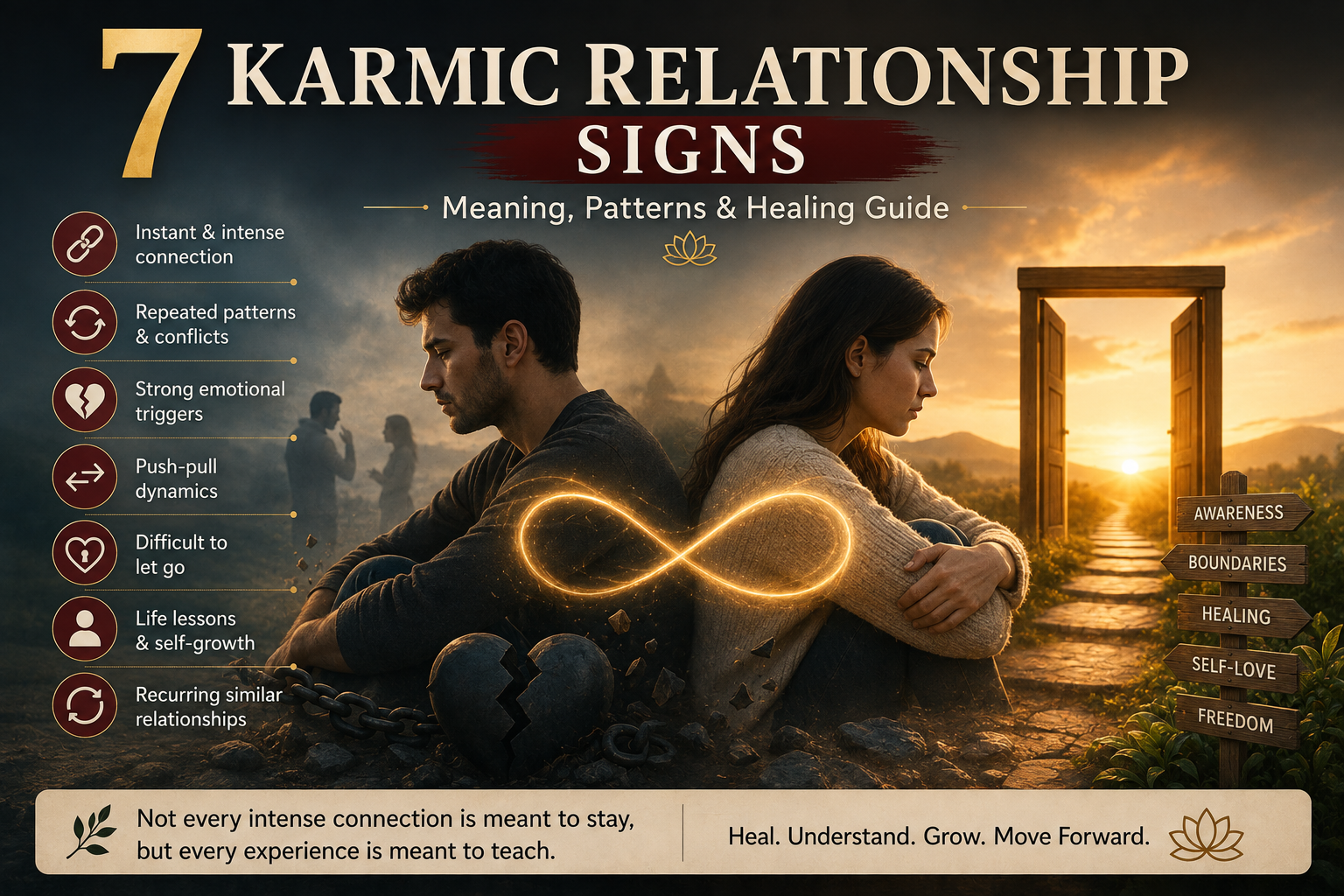
In this guide, we’ll explore 7 signs of a karmic connection, what the concept means, how to recognize repeating patterns and how healing can be approached in a grounded way.
Table of Contents
- What Does Karmic Relationship Mean?
- 7 Signs of a Karmic Connection
- Why Do These Relationships Feel So Intense?
- Karmic Connection vs Healthy Relationship
- Can a Karmic Relationship Be Healed?
- How to Break Repeating Relationship Patterns
- When Is It Time to Let Go?
- Exploring Relationship Karma Healing
- Frequently Asked Questions
- Final Thoughts
What Does Karmic Relationship Mean?
The phrase karmic relationship meaning comes from spiritual interpretations of karma and relationships.
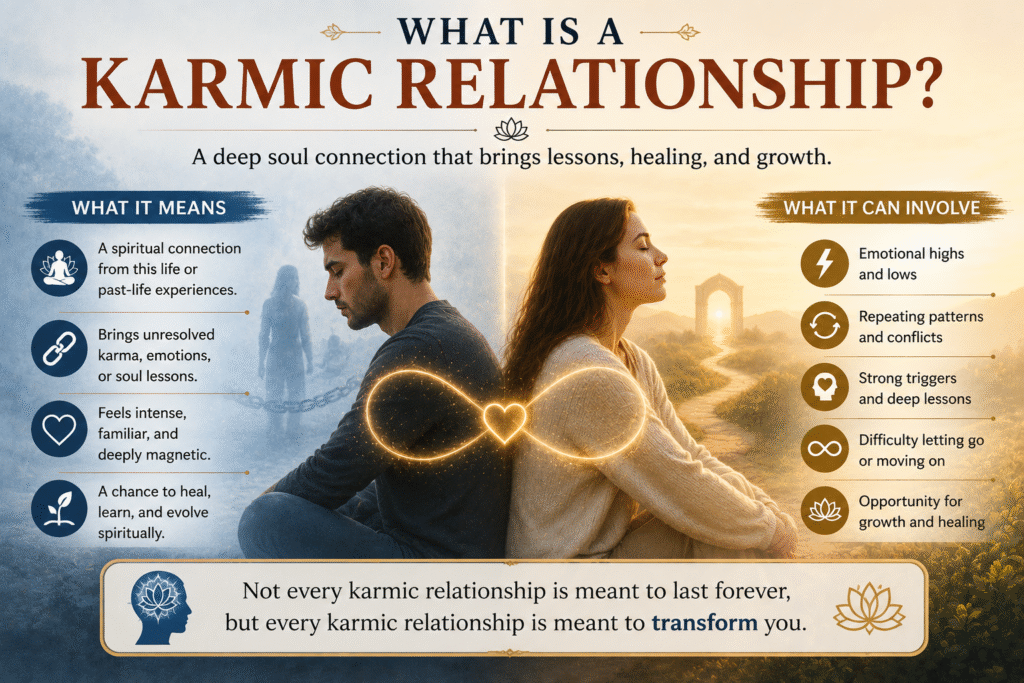
In modern spiritual communities, it is often used to describe a connection that feels unusually intense and seems to bring recurring emotional lessons or unresolved themes into someone’s life.
People may describe experiences such as:
- instant familiarity
- powerful attraction
- repeated conflict
- emotional highs and lows
- difficulty letting go
- strong personal transformation
- recurring relationship patterns
There is no clinically recognized definition of a karmic relationship. Mental-health and relationship professionals may instead describe some of these experiences using concepts such as attachment, codependency, emotional dependency or unhealthy relationship dynamics.
So, the spiritual interpretation and psychological interpretation can be considered separately.
7 Karmic Relationship Signs to Look For
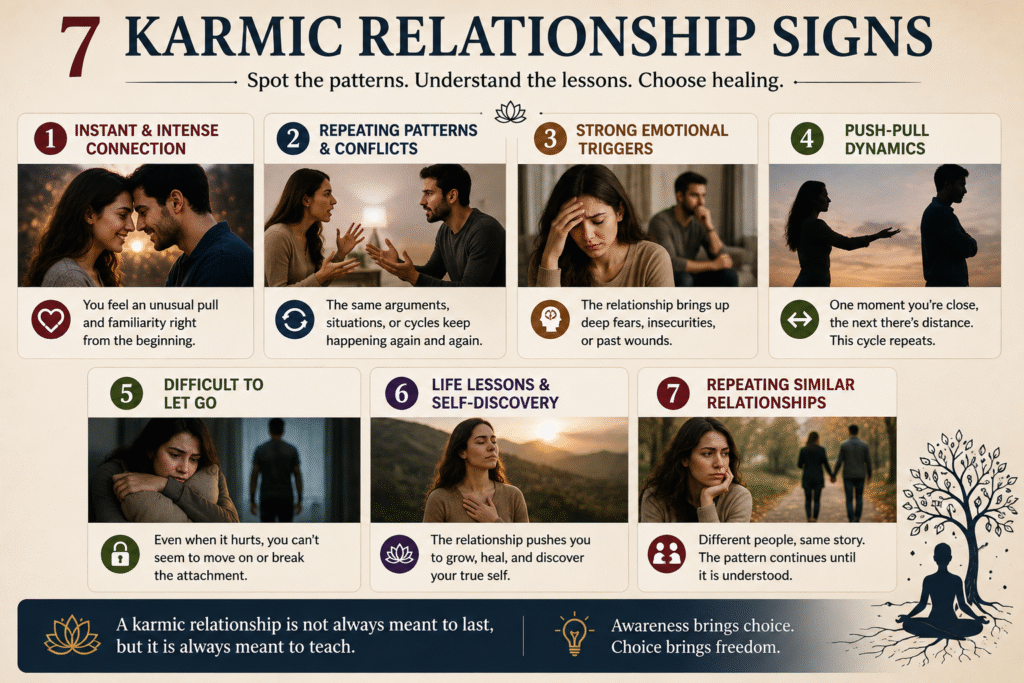
These signs should not be treated as a test or diagnosis.
They are simply possible patterns that may encourage self-reflection.
1. The Connection Feels Familiar Very Quickly
You meet someone and immediately experience a strong sense of familiarity.
You may think:
“I feel like I’ve known this person forever.”
The attraction may develop quickly and feel unusually powerful.
Some spiritual traditions interpret this as a sign of a past-life or karmic connection.
From a psychological perspective, rapid familiarity can have many possible explanations, including shared interests, attachment patterns, emotional compatibility or projection.
The important question is not simply how intense the beginning feels.
Ask:
“How does this connection make me feel over time?”
2. The Same Conflict Keeps Returning
One of the clearest patterns to observe is repetition.
You may have the same disagreement again and again.
The conversation ends.
Both people promise to change.
Things improve temporarily.
Then the same issue returns.
For example:
Conflict → apology → closeness → trigger → conflict
If this cycle continues, it may be useful to examine the underlying issue rather than focusing only on the latest argument.
Recurring conflict is also one of the patterns frequently discussed in current relationship resources about this topic.
3. The Connection Brings Strong Emotional Triggers
A particular person may activate emotions that feel surprisingly powerful.
You might experience:
- fear of abandonment
- jealousy
- insecurity
- anger
- rejection
- anxiety
- fear of losing the relationship
Sometimes the relationship itself isn’t the only factor.
It may also be activating an older emotional wound or familiar pattern.
This is an opportunity to ask:
“What is this experience showing me about my own emotional needs?”
4. You Experience a Push-Pull Dynamic
One moment you feel extremely close.
Then suddenly there is distance.
You try to reconnect.
The other person withdraws.
Then they return.
The cycle begins again.
This can create:
Closeness → distance → anxiety → reconnection → conflict
A push-pull dynamic can occur for many psychological and relational reasons, so it should not automatically be interpreted as evidence of karma.
What matters is whether the pattern is healthy and whether both people can communicate and respect boundaries.
5. You Find It Extremely Difficult to Let Go
Sometimes a connection continues to occupy your thoughts even when the relationship is causing distress.
You may repeatedly think:
“Maybe things will change.”
“Maybe we’re meant to be together.”
“Maybe I just need to give it more time.”
Strong attachment can make separation difficult.
A spiritual interpretation may describe this as a karmic bond.
A psychological perspective may examine attachment, dependency, fear of loss or unresolved emotions.
Either way, awareness can help you make more conscious decisions.
6. The Relationship Forces You to Look at Yourself
Some relationships reveal parts of ourselves that we would rather avoid.
You may suddenly become aware of:
- weak boundaries
- people-pleasing
- fear of rejection
- difficulty trusting
- low self-worth
- communication problems
- fear of being alone
This can be uncomfortable.
But it can also become an opportunity for personal growth.
Instead of asking only:
“Why are they treating me this way?”
try asking:
“What am I learning about myself through this experience?”
7. You Keep Recreating Similar Relationships
This is perhaps the most important sign to examine.
Different people.
Different circumstances.
But the same emotional story.
For example:
Emotionally unavailable partner → anxiety → overgiving → disappointment
Then another relationship:
Emotionally unavailable partner → anxiety → overgiving → disappointment
When this happens repeatedly, the focus can shift from finding “the right person” to understanding the pattern itself.
This connects directly with our article on same relationship patterns, which explores why recurring relationship dynamics can appear with different people.
Why Do These Relationships Feel So Intense?
There isn’t one universal explanation.
Intensity can come from:
- strong attraction
- emotional vulnerability
- attachment dynamics
- unresolved experiences
- idealisation
- uncertainty
- inconsistent attention
- communication patterns
Within spiritual traditions, people may additionally interpret intensity as a karmic or soul connection.
Current articles on the topic commonly describe these bonds as emotionally intense, volatile or difficult to leave.
But intensity alone doesn’t prove that a relationship is spiritually destined.
A healthy relationship should still include:
- respect
- consent
- communication
- trust
- emotional safety
- boundaries
Karmic Connection vs Healthy Relationship
Use this table to understand the difference.
| Repeating Difficult Pattern | Healthier Dynamic |
|---|---|
| Constant emotional highs and lows | Greater emotional stability |
| Same argument repeatedly | Problems are discussed and resolved |
| Fear controls decisions | Choices are based on values |
| Poor boundaries | Clear boundaries |
| One person constantly gives | Mutual effort |
| Emotional exhaustion | Emotional support |
| Repeated breakups and reunions | Consistent communication |
A powerful connection isn’t automatically a healthy one.
And a difficult relationship should never be romanticized simply because it feels “destined.”
Can a Karmic Relationship Be Healed?
The answer depends on what you mean by healing.
If healing means changing another person’s behaviour, no spiritual practice can responsibly guarantee that outcome.
If healing means understanding your own emotional patterns, developing boundaries, processing difficult experiences and making healthier choices, there are many possible paths.
These can include:
- therapy
- counselling
- journaling
- meditation
- relationship education
- emotional awareness
- boundary work
- spiritual practices
For people who follow a spiritual path, karmic relationship healing may be one framework for exploring recurring emotional or relationship themes.
How to Break Repeating Relationship Patterns
Step 1: Name the Pattern
Write down what keeps happening.
For example:
“Whenever someone becomes distant, I become anxious and start overgiving.”
Specific observations are more useful than saying:
“All my relationships fail.”
Step 2: Identify Your Trigger
Ask:
What happens immediately before my emotional reaction?
Is it:
- delayed communication?
- criticism?
- rejection?
- uncertainty?
- emotional distance?
Understanding the trigger gives you a place to begin.
Step 3: Examine Your Boundaries
Ask yourself:
- What am I tolerating?
- What am I afraid to say?
- Where do I ignore my own needs?
- What would a healthy boundary look like?
Boundaries are not punishments.
They communicate what you are comfortable accepting and how you will respond when those limits are crossed.
Step 4: Stop Trying to Control the Other Person
You cannot make another person:
- communicate better
- become emotionally available
- commit
- change their behaviour
- heal their wounds
You can control your own choices.
This shift can be extremely important.
Step 5: Decide What You Want to Learn
Ask:
“What is this relationship teaching me?”
Perhaps the answer is:
- self-respect
- emotional independence
- communication
- boundaries
- forgiveness
- letting go
The lesson doesn’t have to mean that you must stay.
Sometimes growth involves leaving.
When Is It Time to Let Go?
A spiritual label should never become a reason to remain in an unsafe relationship.
If there is:
- physical violence
- threats
- coercion
- manipulation
- stalking
- controlling behaviour
- persistent emotional abuse
prioritise your safety and seek appropriate support.
Psych Central specifically warns that describing an unhealthy relationship as “karmic” can sometimes encourage people to remain in harmful situations because they believe they are supposed to learn a lesson from the relationship.
A lesson is never a reason to accept abuse.
Exploring Relationship Karma Healing
At The Healing Wiz, Relationship Karma Healing is presented as a spiritual approach for exploring recurring relationship experiences.
The existing program describes areas including:
- karmic ties
- soul contracts
- recurring relationship cycles
- emotional wounds
- energetic cords
- past-life relationship concepts
and focuses on recognising patterns and exploring healing through its spiritual framework.
If this approach resonates with you, the goal should be self-awareness rather than dependence on a practitioner.
Frequently Asked Questions
What is the meaning of a karmic relationship?
It is a spiritual concept used to describe an intense connection associated with recurring emotional themes, lessons or unresolved experiences.
What are the main signs?
Possible signs include intense familiarity, repeated conflict, emotional triggers, push-pull dynamics, difficulty letting go and recurring relationship patterns.
Are karmic relationships always toxic?
No. The term itself doesn’t determine whether a relationship is healthy or unhealthy. The actual behaviour and dynamics matter.
Can a karmic connection become healthy?
It may become healthier if both people communicate openly, respect boundaries and are willing to change unhealthy behaviours.
What is karmic relationship healing?
It is a spiritual or holistic approach used by some practitioners to explore recurring relationship patterns and emotional experiences.
Do karmic relationships always end?
No. There is no universal rule that these relationships must end. The outcome depends on the people and the relationship itself.
How can I stop repeating the same relationship pattern?
Begin by identifying recurring triggers, examining your boundaries, understanding your emotional responses and making different choices.
Is a karmic relationship scientifically proven?
No. “Karmic relationship” is a spiritual concept rather than a clinically recognized or scientifically established relationship category.